
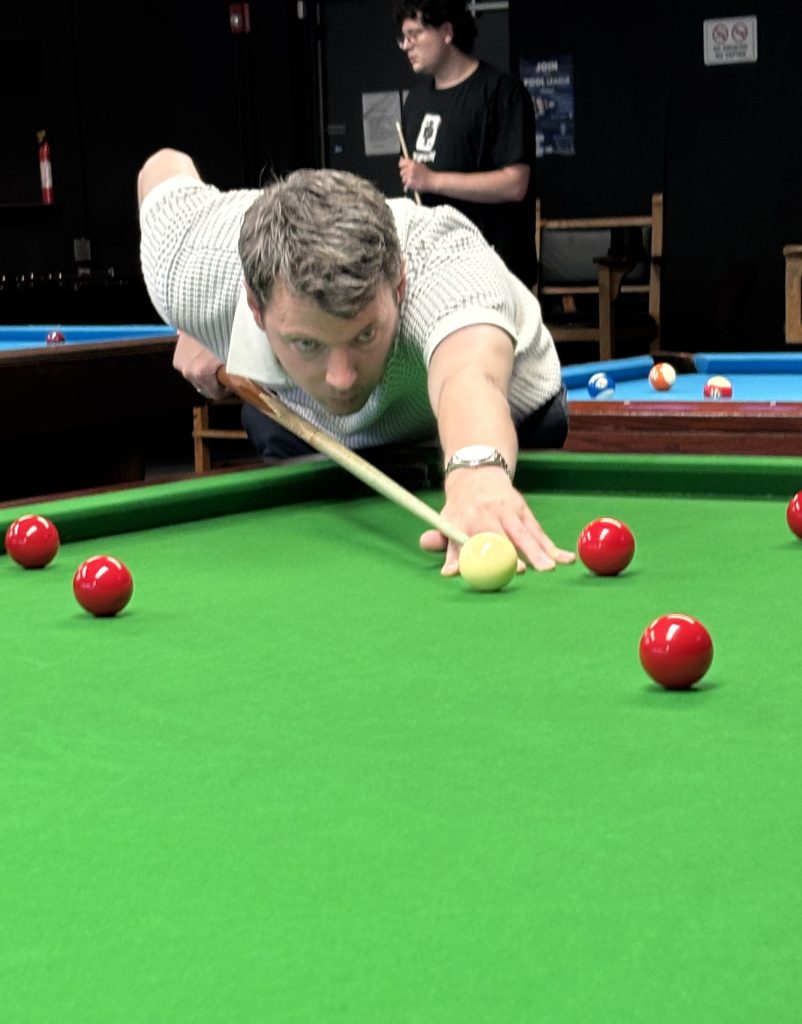
David returns to the snooker hall in 2025.
Note: Knucklebones is produced and designed to be heard. If you are able, we strongly encourage you to listen to the audio, which includes emotion and emphasis. Abbreviated transcripts are generated using a combination of speech recognition software and human transcribers, and may contain errors. Please check the corresponding audio before quoting in print.
Monica: From age 11 to 16, David rose to the top of his sport. His game: snooker. Today we take a look at what it means to have been at the top of your game. Being a skilled player can bring fame and recognition. But can lead to surprising pitfalls as well.
David (Excerpt): I was smoking and drinking, chasing girls, larking about for the most part, and I got taught a very valuable lesson.
Monica: Today we hear one person’s story about the high-flying world of snooker and the role it played in his life.
Welcome to Knucklebones, a narrative podcast where we talk about the impact of games in our everyday lives. And for today’s episode we ask: what is it like to have been the best at your game? Many of you listening may have been the best in your club, your state, or your region. I’m looking at you, former high school chess champions, former college quarterback, or maybe you were the best Magic player in your friend group. When you look back at when you were at the top of your game, is it with fondness? What lessons did you learn?
Well, today we’re delving into the world of snooker. Now if you’re not familiar with snooker, you’re…well, probably American. The game of snooker was big business in the United Kingdom, and the 1980s televised snooker matches reached a peak viewership of over 14 million viewers. When the game reached its height in 1986, there was even a popular song about the game that reached number 6 on the charts, “Snooker Loopy.”
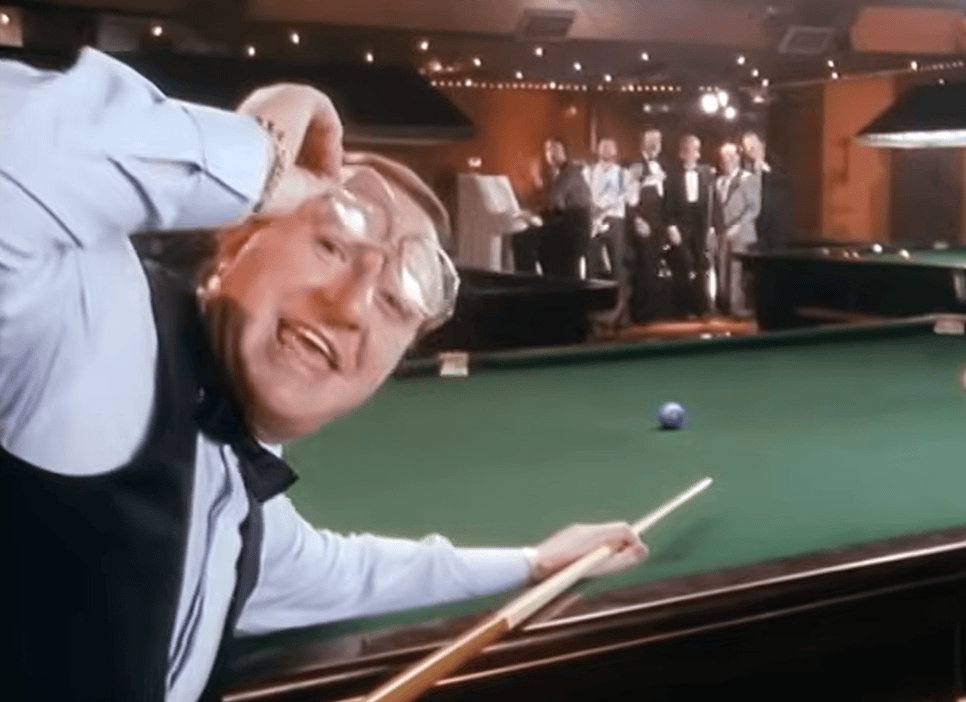
Source: https://www.youtube.com/watch?v=h0UVXBkqA4I&list=RDh0UVXBkqA4I&start_radio=1, Chas & Dave, “Snooker Loopy”
Today we talk to one of the few to reach a professional level early in life. I was curious to know if he looked back on those years as a highlight, if he missed the competitive snooker scene, and how snooker changed his life.
Monica: I’m joined today by my good friend, David.
David (to the listeners): Hi, pleased to meet you.
Monica: Thank you so much for joining us on Knucklebones. And David, I thought this would be an interesting interview because you have a life experience that most people don’t have. Could you tell us a little bit about snooker?
David: Sure. So, snooker is a sport which is popular in England, but pretty much the United Kingdom as a whole. But it has got a significant foothold now in China and Southeast Asia as well, such as in Thailand. Even though I will actually say there was a world champion probably about a decade ago which was Belgian that came out of nowhere.
But it’s a larger version of billiards. It goes back to the British Raj where it started. And it used to be a very popular sport and had started to wane in more recent years.
Monica: So, for anybody who’s not familiar with snooker, it might be fair to compare it to pool / billiards, right? What is the important difference just in a nutshell to you?
David: So, snooker is on a much larger table. The pockets are smaller and you have a lot more balls and it’s more sort of a strategy game. A lot of people think of it as chess that you are playing at least three or four moves ahead. It is all about positioning.
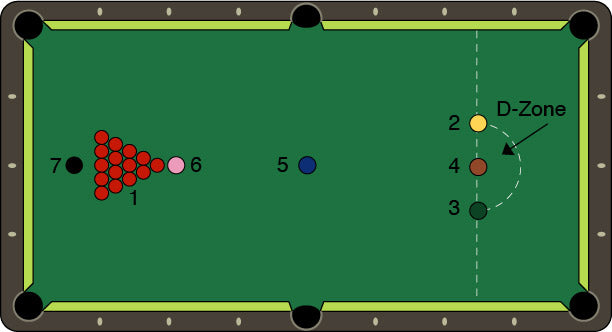
Source: https://www.billiards.com/blogs/articles/official-bca-snooker-rules?srsltid=AfmBOortXc6ZqXv-gjRQMlapaXjxThYLCeNtQkHF4B0pH2wyCxiZ-di6 “Official BCA Snooker Rules”
So, you have slightly more balls. You have the triangle which is just red balls. They count as one point. You have yellow which counts as two. Then green, moving up three, then brown, then blue, then pink, then black. The reds are all in a huddle and the colors are actually scattered around the D and in the middle of the felt. What you’re hoping to do is get the highest score possible.
[…] You want to try and cash in on as many colored balls as possible. So, it will alternate: red, colored, red, colored. But you aren’t aiming for the highest score. So, ideally you’re going to want to go: red, black, red, black. If that’s not available: red, pink, red, pink. Maybe you can get a pink and you can circle back to the black. With top flight players, it is not uncommon for them to reach a century, which is 100 points. […]
Monica: And what I love is that one of the strategies is also the name of the game: snookering. For anyone who’s not familiar with snookering, what is that?
David: […] Snookering is where you ideally are trying to hide the cue ball behind a colored ball. And that can happen in many ways. Usually you can put a spin on it, you can make a banana shot. But you are trying to hide it. And once you hide the cue ball behind a color ball, and I can’t reach a red or I miss the red, it is four points to the opposition.
Monica: It’s a game of accuracy, a game of skill, you have to really almost have a geometric mind to kind of envision the angle where it’s going to go in, angle where it’s going to pop out, and not just hitting the ball and sinking it, but imagining where your cue ball is going to land afterwards. So, it takes a great deal of skill, almost – not to offend American audiences, but -almost a little more complicated than billiards.
David: It is. I don’t want to be rude myself. Just the same as darts, billiards/pool is a pub game. It’s a bar game. I think every snooker player under the sun plays pool. I play pool myself even though I’m primarily a snooker player. Pool is a great game. It’s just over very quickly. Not many people want to spend an hour plus on a Snooker table, and if you’re not that good, you can easily spend two, two and a half because both of you are struggling.
Monica: I mean, full disclosure, you taught me how to play Snooker – attempted to teach me – and, we tried playing a game. We were there an hour and a half and still didn’t finish, and that’s on me. Just learning the rules of the game and even just the logistics of it, it is a longer, fuller game.
David: It is, and I think you’ve been a bit unfair in yourself there, because back in the day, 20 years ago or so, I could have cleaned up in 20 minutes, maybe under. But I’m a bit out of sorts myself, and it is a game where you really have to keep on top of it. These snooker players, they have snooker tables inside their house, and they play it from morning to night, trying everything, every position, hiding the ball themselves, making trick shots. And yet, they’ll still come to the big stage, whether that’s the Masters, or an international somewhere, and they choke […] everyone deals with pressure differently, and whether that is making a mistake or overthinking something.
Monica: So, something that not everybody knows about you is that you have a history as a very strong snooker player. Can you talk a little bit about any competitions you played in the past, and where that fit into your life?
David: Sure. I think I actually go back to how it all began. I joined Secondary School at 11 years old, which I believe is a crossover of middle school into high school. And I didn’t really watch snooker. I was a big football fan as in soccer, and I really just, you know, all my mates were saying, “we’re going to the snooker hall”. I played pool in with my dad on a holiday or something like that, but you’re allowed to be in a pub as long as you’re with an adult in Britain at any age. And we were playing a couple of games at pool, and that’s how I started off.
It used to cost 50 pence, and so my parents used to give me two quid, and if you’re playing with another person, that’s eight games. And so it cost two pounds. I remember I had a mate, Neil, and I had Graham, and I had James, and we would all just sit around the snooker players and just watch them play.
And the first time I played it, I mean, it was hard. I just wanted to walk away completely. It was a complete different game, but I started to spend every night down there, and I think it’s where a lot of the young English youth in particular would to spend time was in snooker halls in my area.
There’s at least eight snooker halls. They were everywhere. Unfortunately, they’re all closed down now, as it’s fallen out of favour. I slowly got better and better and my dad encouraged it. He played me and he would put balls in certain positions, and he was like, get out of that.
And so I would just keep working, keep working. And along came a young lad, Paul Hunter. He was known as Beckham of the Bayes. And he was a really good looking chap, very suave. Girls all around him, typical blond hair cut like David Beckham, and I think he became like a superstar that we all needed. That the sport needed.
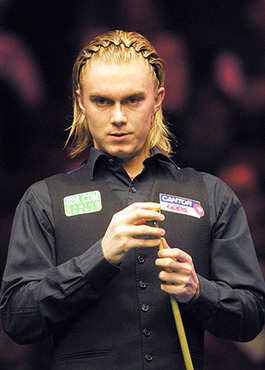
Photo: Paul Hunter (aka “Beckham of the Baize”). Source: https://jacksw14.files.wordpress.com/2017/02/paul-hunter-1.jpg, Fair use, https://en.wikipedia.org/w/index.php?curid=69988705
A lot of boys wanted to be like him, and so we all started making extra effort into wanting to play.
I was offered a chance to play pool for my club. I played and I cleaned up very quickly. Me and Neil were probably the strongest players at our local club.
But I wanted to play snooker, and so I inquired, and they said you can play in it, but we don’t think you’re good enough. And I said well, let me give it a try. I lost a couple of games in the beginning, and then I think about six or seven months down the line, I went in for a competition, and I wo – and I won by quite a large margin.
And so I kept on playing for my club. I won about nine out of ten [games], and they said, would you like to play for North London? And I said, sure, I’ll play for North London. Won pretty much every match after that, every frame. And they said, we’d like you to play for London as a whole, and I said, I absolutely would.
I won pretty much every game, and I was actually playing against some players that are world famous now. I didn’t win by a large margin. But I slowly went up in the hierarchy. I was to represent Southeast England, and then I represented a little bit further along to represent England, and that’s where unfortunately it all fell apart.
I’ll be totally honest about it, I messed it up myself. I was smoking and drinking, chasing girls, larking about for the most part. And I got taught a very valuable lesson. I think I played six or seven games, and I barely even got out my chair for any seven of them. I made one mistake, and that’s all that these people needed.
Monica: You’re saying they were just dominating the table the whole time. You had no chance to get up.
David: I mean, if I’m going to make a mistake, I’ve got to hope that it either hits the cushion, and just is an awkward position to get out of, or it’s a snooker. But I didn’t. I left one red open, and that was all that they needed to wipe me out. I feel like I’ve reached a good modicum, but I think I could have been a lot better if I had just knuckled down. But you could say that for any spor…if you lark around and don’t pay attention, then people who dedicate their entire lives to it are going to come for you.
Monica: So when you started your story, you were 11, going to the snooker hall with your dad,
David: With the boys originally.
Monica: And when did it end for you?
David: I think I stopped playing, I believe when I was 16, going on 17. That was where it really just fell off. I did carry on going to snooker halls all the time, probably all the way through age 24 or 25…and when a lot of places closed down, the ones that were remaining were charging a hell of a lot more. And on London wages, especially at that time, it was impossible to keep up.
Monica: So these are formative years in your life. You were a teenager, 11 to 16, it sounds like, but you were one of the best, right? Not a lot of people have that experience, where they’re at an above-average, really strong level at a sport or a game.
I’m curious – when you think back on that time, and it’s been some time now, how do you think it shaped you?
David: […] I believe that taking chances in life is the only way you can ever move forward.
Monica: Just thinking about the social importance of snooker in the UK…it sounds like it really was in its heyday in your youth. Did your friends or family treat you any differently, especially when you were moving up through the circuit?
David: I will say its heyday was probably in the 70s, especially when TV became colour.
Monica Probably made the game a lot easier to follow.
David: I think my parents encouraged me just being out, being with my friends. But when they saw I was getting good, they would always come along and watch me. Snooker again is a well respected sport, it’s aired on TV.
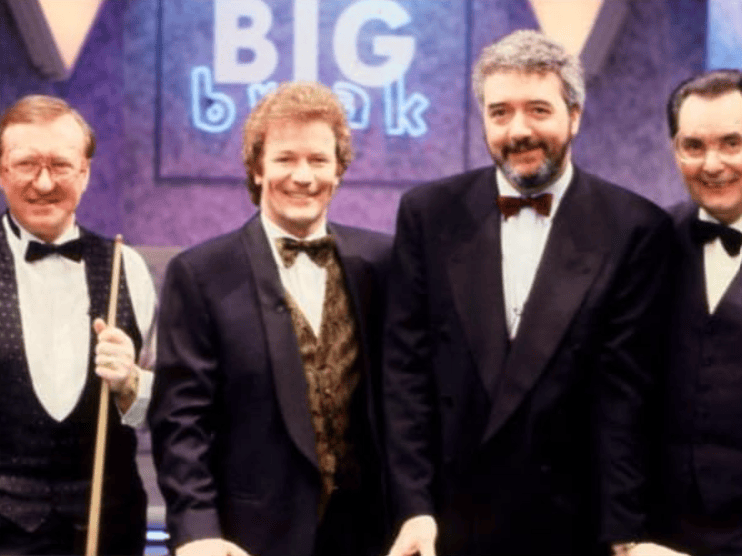
Screen still from the 1990-2002 TV show, “Big Break”. General knowledge game show where contestants team up with snooker stars testing their skill against the clock. Source: IMDB.com , https://www.imdb.com/title/tt0262945/mediaindex/?ref_=mv_close
Monica: I know you do occasionally watch some of the competitions. When you see some of the exciting new players and people who are really doing the best that they can to bring it to the younger generation, are you ever tempted to compete again?
David: I think the internet especially has given us a false perspective of how good everyone is.
If I was to type in how to play guitar, how to write a story, the algorithm will always show you the best of the best. And it makes you feel like you just want to put down your guitar. It makes you feel like you don’t want to play football, it makes you feel like you don’t want to play chess. Because everyone seems amazing, but it’s been a controlled environment, maybe it’s been set up for the video […] And I think the same goes for Snooker. It is still an open game. Once you get out of the top flight, you can easily join as an amateur. And I think I could play well. I think that semi-professional is also a possibility for me. It will take a lot of practice months of practice to get back in. But I think at an older age you have more confidence to just walk out. I’ve got nothing to lose, whereas the kids got everything to lose.
I’m a big boxing fan as well. And if you ever watch boxers, you see that it’s a couple of swings at a professional level, a bit of panting, a bit of holding onto each other. Then you watch these amateur boxes who were 17, 18. They are just going for each other like a pack of wild dogs. And it’s because it’s no guts and glory. And so I think that they’ve got everything to lose. So it’s either all in or they become extremely cautious.
And so I can come in and that’s actually what’s happened at pa rofessional level. We’ve got some 60-year-olds that have come back to the game because the young generation is bringing nothing. And so they realize they can come back, which never would have happened a decade or 20 years ago.Once you’re out, you’re out.
Monica: Definitely true for boxing.
David: It’s definitely true for Snooker.
Monica: Well, if you were to come back, do you think you would play in the same way? You were talking about clinical players versus your style.
David: I would probably be even more reckless. I think that people want to watch good snooker.
Monica: I think one of the things I’m most interested in is people who are looking back at a time in their lives when it seemed like that was their moment; that was their peak for a particular game or sport. And I mean, American football right is very popular here. If you talk to folks in their 30s or 40s, they’ll talk about their time on the high school football team as the glory days.
They’ll look back and it’ll be with real bittersweet emotions because that’s a very physical sport.
You definitely can’t pick that up again. And it seems that they approach it as: “that was me at my best. And it’s just been downhill every since.”
And I’m just curious about games that you can play at any age or any level. When you’re looking back at your teenage years, 11 to 16, playing all these top names. And not playing for many years since then.
David: I don’t want to hearken back to any time. I look back with fondness. There are friends that I miss. As you said, I don’t really speak about snooker. I keep it kind of under my hat. The same as I wrote poetry, but I won’t call myself a poet. And I did art, watercolor. People may call me a failure at all three. People may call me a success at all three. I actually disagree with either.
I achieved a success which is good by my standards and that’s what matters. You know, it’s how you view things on your own. Did most snooker players, young kids, play top names that went on to become top names? Probably not. Which means I know that I was of a certain level. People write poetry all the time but they don’t publish a book. I did. Whether or not it sold thousands of copies is immaterial. It’s the fact that somebody saw something in it. Van Gogh never sold a painting in his entire life. I’ve sold hundreds. Does that make me better than Van Gogh? No. But by my standards I like it.
I see it all as a fond memory. And I think that if I had to become a big snooker player, knowing myself and myself at that age, would I still be here is another question. I think that I have more akin to (Alex “Hurricane”) Higgins at that age. I think I would have been drinking all the time, lots of women, lots of smoking. I don’t think I would have gotten into drugs, but I might have drunk myself into nothing. And I think that the man I was, or the boy I was, would have not been able to not deal with it.
I would have dealt with it, but I would not have enjoyed it too much. I would have taken it to excess. And so I’m happy with the way my life has gone. I think that my life has gone 90% of the way that I wanted it to go. I’ve achieved what I set out to do… I’ve lived out my dream.
Monica: Last question – if you were to go back, and it turns out you’re a strong player now, would you be worried about getting sucked into the glitz and glamor of the snooker scene?
David: Good God, no. I am an “Ovaltine and into bed by 9 o’clock” kind of person now. No, I know what’s important in life now. I’m glad I’ve grown up. It’s one of the things I can look back on, and be like, “yeah, I have actually grown up a lot.”
[…] I’ve realised what’s important, and what is important is spending the time with somebody. I’m currently engaged. I want to share my life with somebody. I tell my fiancée these stories, and it makes her laugh. And, to be honest, making her laugh and just sharing a story is actually nice.
There’s no grievance about it. I actually find it a funny story that I was like, “yeah, doing great, doing great, yeah, doing great, and then: wipe out.”
I mean, it happened almost overnight, and it was a hell of a wake-up at my level. But you’re as good as you are, and I know that I didn’t put in the effort. I know I didn’t. I think if I had, if I’d dedicated my entire life to it, yeah, maybe I would be there, but that will come with another issue.
So I’m happy where I am, and I’ll probably go back to it at one point. It’ll be nice to play somebody. And if I lose, I lose, if I win, great, do you want to have another frame and see if you can beat me in the next frame? You know, it will be nice to be tested.
Monica: Well, thank you so much for joining us.
David: Thank you.
Episode written and produced by Moncia Felix. Music by Eric Matyas and downloaded from http://www.soundimage.org.


Leave a comment